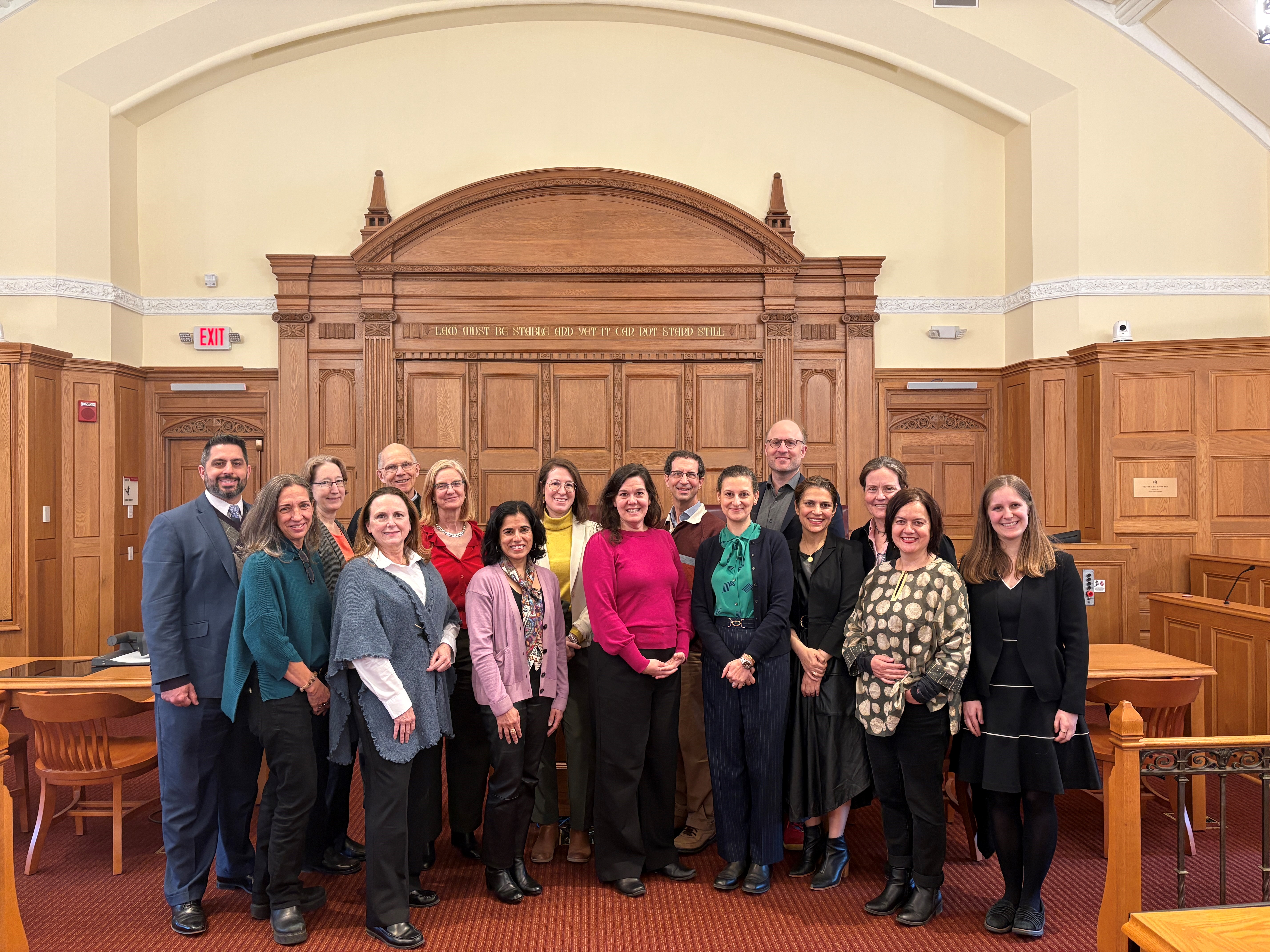
The 2025–26 fellows cohort during a retreat at Cornell Law School.
Cornell Law School’s Migration and Human Rights Program announced its expanded cohort of Immigration Law and Policy Fellows, bringing together an ideologically diverse group of immigration experts with experience at the highest levels of government, business, and advocacy.
At a time when immigration policy remains highly polarized, the Migration and Human Rights Program offers a space for nonpartisan, evidence-based collaboration. The fellowship brings together senior leaders to find solutions to the most pressing challenges in immigration law and policy.
The Fellows program, which started in 2021 and is supported by grants from multiple philanthropies, represents one of the longest-running initiatives of its kind. It currently functions as a laboratory where practitioners from across the political spectrum collaborate on pragmatic policy solutions.
“This fellowship exemplifies Cornell’s mission to connect research and practice in pursuit of the public good,” said Jens Ohlin, dean of the Cornell Law School. “By bringing together leaders from government, business, labor, and advocacy, the program is shaping a balanced national dialogue on immigration.”
The fellowship is distinguished by its cross-sector makeup. Fellows include multiple U.S. Senate-confirmed officials, senior executives from leading business organizations, civil rights leaders, and government administrators who have shaped immigration policy under presidents from both parties.
The current Fellows cohort includes:
- Jonathan Baselice, former vice president of immigration policy at the U.S. Chamber of Commerce, who played a crucial role in shaping business immigration advocacy and engaging with Congress on comprehensive reform.
- Dan Berger, an expert in immigration law who played a key role in President Biden’s waiver program for Dreamers, and is a legal adviser for the bipartisan Congressional Coalition on Adoption.
- Michelle Brané, who held high-level roles at the Department of Homeland Security and is a former director of the Migrant Rights and Justice Program at the Women’s Refugee Commission.
- Theresa Cardinal Brown, who brings almost 30 years of experience spanning the U.S. Chamber of Commerce, roles in both Bush and Obama administrations, and the American Immigration Lawyers Association.
- Marielena Hincapié, former executive director of the National Immigration Law Center and a pioneering advocate for immigrant justice and civil rights.
- Randel Johnson, currently chair of the Department of Labor’s Administrative Review Board and a former senior vice president of labor, immigration, and employee benefits at the U.S. Chamber of Commerce.
- Charles Kamasaki, former executive vice president of the National Council of La Raza (now UnidosUS) and a veteran of immigration reform efforts spanning four decades.
-
Avideh Moussavian, former senior advisor to the director and chief of the office of policy and strategy at U.S. Citizenship and Immigration Services and, previously, director of federal advocacy at the National Immigration Law Center.
- Bitta Mostofi, former senior advisor at U.S. Citizenship and Immigration Services and former commissioner of New York City’s Mayor’s Office of Immigrant Affairs, specializing in state and local immigration policy.
- Seema Nanda, former Solicitor of Labor in the Obama administration, leading a team of 500 attorneys, and former CEO at the Democratic National Committee.
- Amy Nice, former assistant director of the White House Office of Science and Technology Policy, where she led initiatives on STEM talent policy, and former executive director for immigration policy at the U.S. Chamber of Commerce.
- Margaret O’Herron, former senior policy advisor for immigration at the Executive Office of the President, who was instrumental in developing President Biden’s domestic immigration agenda.
- Tricia Swartz, senior advisor at the Department of Health and Human Services’s Administration for Children and Families, specializing in unaccompanied children policy, who has held other roles in the HHS and the Department of Homeland Security.
- Emily Tulli, a recognized expert in labor and immigration policy who served as senior counsel to the Solicitor of Labor and currently advises national organizations and labor unions.
“The strength of this program lies in bringing together ideologically diverse people who approach immigration from different angles with a shared commitment to finding workable solutions,” said Marielena Hincapié, Immigration Law and Policy Fellow. “We all believe the country deserves and can do better.”
Fellows work closely with faculty and students while developing their own work streams, including policy papers. Currently, this work includes efforts regarding labor-based immigration pathways, the treatment of unaccompanied children, and the role of states and localities in immigration policy.
Through its clinical work, the Cornell Law School’s Migration and Human Rights Program provides legal services to hundreds of clients and has shaped policy and law from local townships to international courts. Recent work under the Path2Papers project, for example, has influenced visa policy for DACA recipients across the country.
“This fellowship creates a space where ideological diversity becomes a strength,” said Alexandra Dufresne, professor of the practice at Cornell’s Brooks School of Public Policy and co-director of the Migration and Human Rights Program. “Our fellows bring deep experience from across sectors and challenge our students and faculty to think beyond ideology, towards what actually works in policy and in people’s lives.”
The Migration and Human Rights Program is co-directed by Dufresne; Jaclyn Kelley-Widmer, Clinical Professor of Law; Ian M. Kysel, Associate Clinical Professor of Law; Beth Lyon, Associate Dean for Experiential Education, Clinical Professor of Law, and Clinical Program Director; and Chantal Thomas, Vice Dean and Radice Family Professor of Law.
