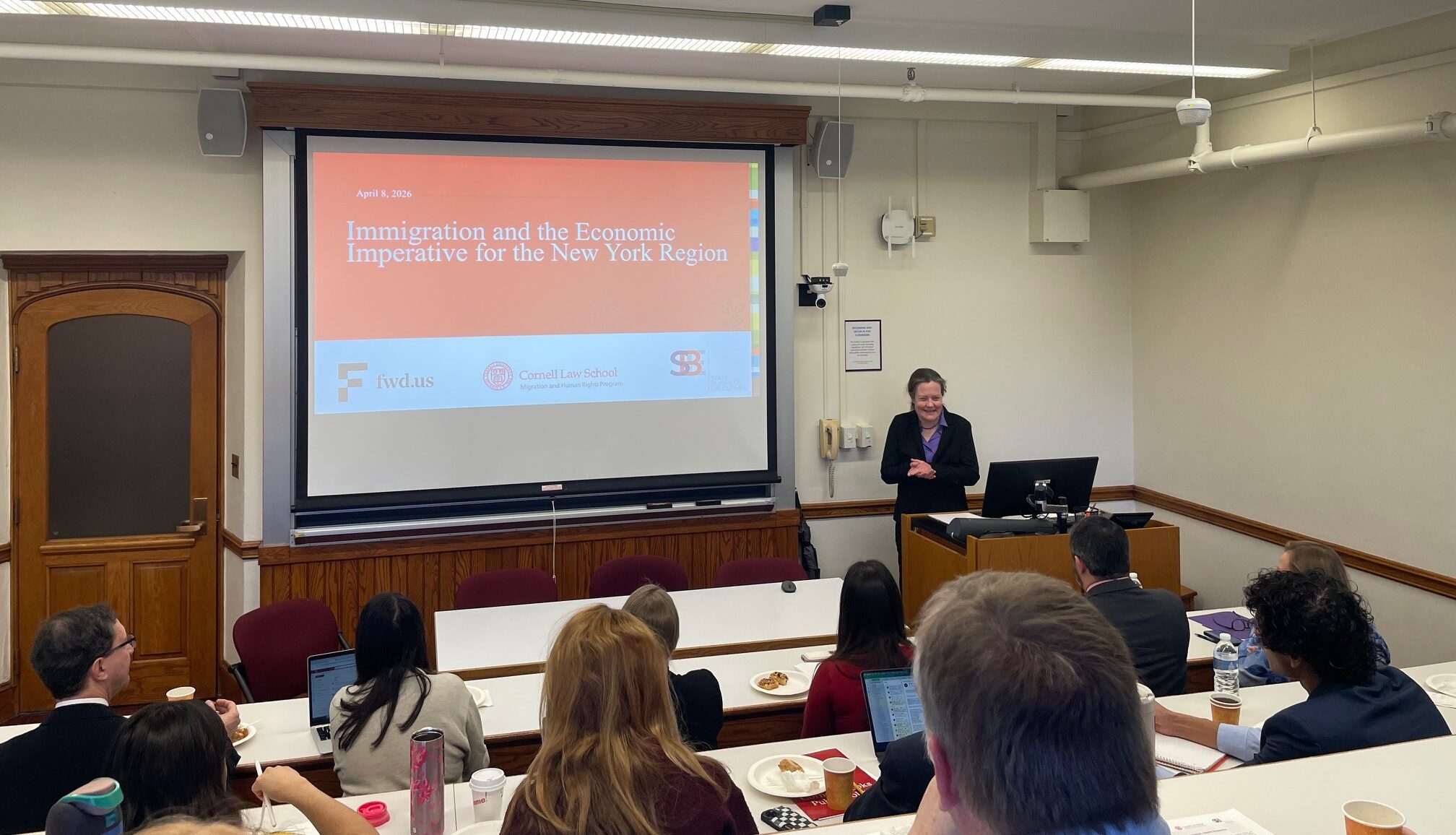
MHRP Co‑Director Alexandra Dufresne delivers opening remarks at the April 8 event, “Immigration and the Economic Imperative for the New York Region”, hosted in collaboration with FWD.us and State Business Executives.
Student Opinion Piece: The Quiet Collapse of Rural Economies
The current immigration policy of the United States is economically incoherent, especially given the current demographic trajectories. As much as our politicians and media would like to make this a partisan issue, it is truly a structural and economic failure exacerbated by both sides of the aisle. The recent “Immigration and the Economic Imperative for the New York Region” panel perfectly highlighted what is really at stake with these economic immigration oversights: persistent labor shortages and rising costs that are killing our rural communities.
The event was divided into two panels, the first brought together Cornell experts to discuss demographic realities and the current labor crisis, particularly in New York state, the second highlighted the real-world effects of visa shortages, with insights from business leaders. Matthew Hall, Professor of Public Policy and Sociology and Director of both the Cornell Population Center and the Program for Applied Demographics, emphasized that New York is facing long-term (and projected future) population decline that is driven by aging populations, low fertility rates, and significant out-migration. With this in mind, work visas are not a policy preference but rather a demographic necessity for our rural economies.
Growing up on a small family farm in northeast South Dakota, and now working in the Farmworkers Legal Assistance Clinic, these issues feel personal. I am continuously disheartened by the deterioration of rural communities, and this panel highlighted that decline, particularly in our agricultural sector. Christopher Wolf, E. V. Baker Professor of Agricultural Economics in the Charles H. Dyson School of Applied Economics and Management, shared that roughly 23% of state land in New York is farmland, and these farms are dependent on H-2A program labor. However, labor costs are rising faster than output, and the H-2A workforce is being continuously depleted by current immigration policies.
The panelists also pushed back on the myth that domestic workers will fill the gap of our immigrant workforce. In reality, though, as emphasized by Ashley Sardo, Manager of National Affairs for the New York Farm Bureau, the United States now relies on other countries for our food, family farms are being forced to close their doors, and rural communities’ economies are failing. Additionally, Gina Mintzer, Executive Director of the Lake George Chamber of Commerce, emphasized that labor shortages extend beyond agriculture into tourism-based economies as well, where seasonal businesses depend heavily on J-1 and H-2B workers to keep their doors open. Without this workforce, the consequences ripple through entire communities: degrading the consumer experiences, discouraging return tourists, and weakening both the short-term and long-term local economy. The question is no longer whether immigration is essential to our economy, but rather, whether our policies will catch up before more communities disappear.
