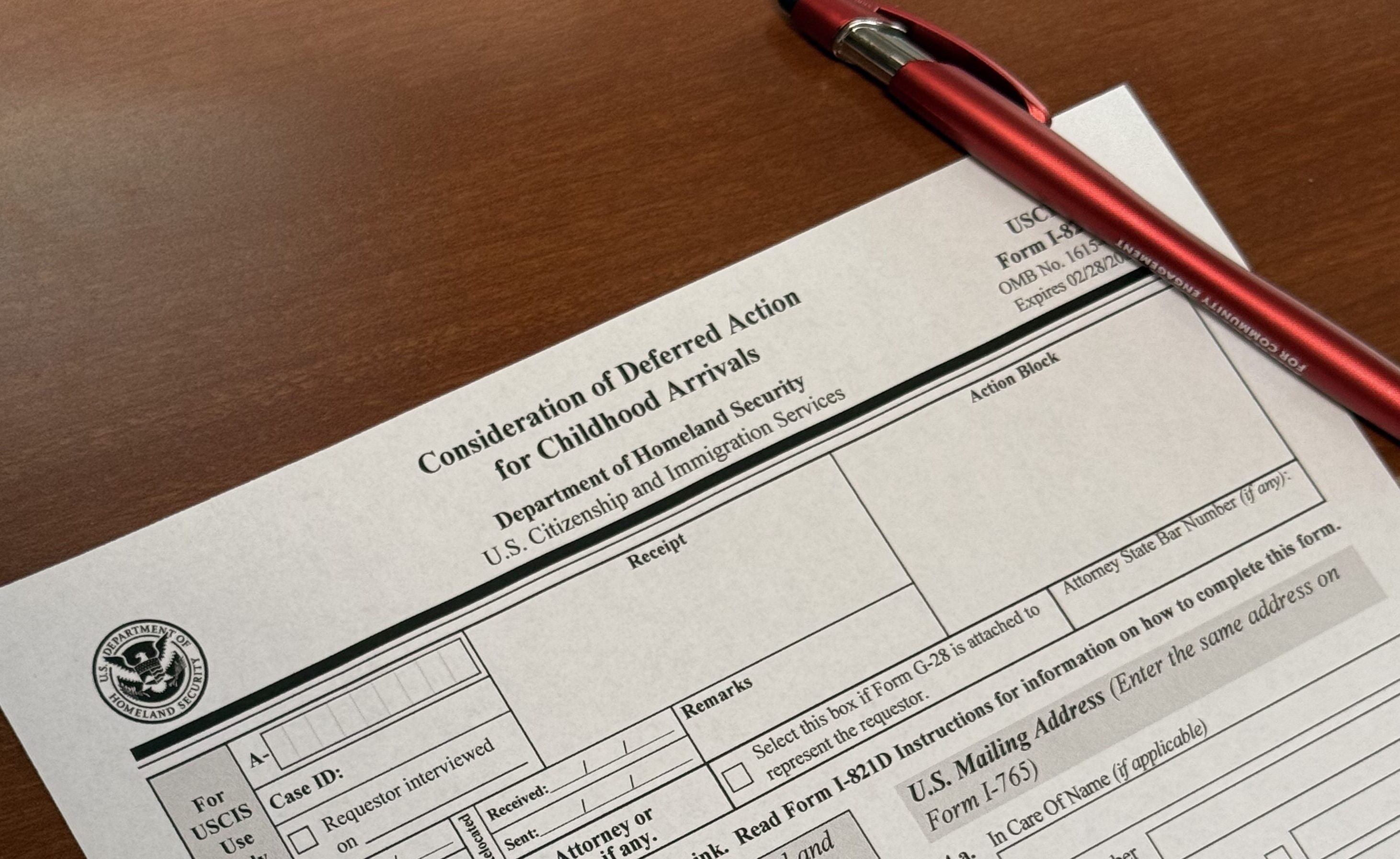
On the fourteenth anniversary of the Deferred Action for Childhood Arrivals (DACA) program, many recipients are confronting a new challenge: lengthy renewal delays that threaten their ability to work, drive, and maintain the stability they have built over the last decade.
Path2Papers, housed at Cornell Law School, works with DACA recipients and others in precarious immigration status to pursue more stable pathways like employment-based visas. Through their legal work, attorneys and advisors are hearing from increasing numbers of DACA recipients whose current protections have expired despite timely filing of their renewals. Others are anxiously waiting and hoping they don’t face the same problem. What used to take weeks is now taking many months, sometimes causing DACA recipients to be laid off or put on leave.
Path2Papers has seen a growing demand for consultations as recipients seek backup plans and longer-term immigration solutions. “We’re seeing people from every profession affected by these delays,” said Raju Patel, an attorney with Path2Papers. “Teachers, healthcare workers, and professionals who have built their lives and careers here are suddenly facing uncertainty because a renewal hasn’t been approved in time.”
One of those individuals is Nayeli (last name withheld), a DACA recipient, mother, and full-time employee. She submitted her renewal application on May 14 and completed biometrics on May 29. Her current DACA status expires August 15.
As of early June, her application remains pending.
“I’m trying not to feel too anxious,” she said. “But it puts so much more added, unnecessary pressure.”
A Program Still Defined by Uncertainty
Established by executive action on June 15, 2012, DACA provides temporary protection from deportation and work authorization for certain immigrants who arrived in the United States as children. While the program has transformed the lives of hundreds of thousands of recipients, it has never offered a pathway to permanent legal status.
Since the program’s early days, some states have tried to undermine the program. The most significant ongoing challenge comes from Texas and other states that sued to block DACA. In 2021, a federal district court in Texas ruled DACA unlawful and barred U.S. Citizenship and Immigration Services (USCIS) from approving new applications, though current recipients were allowed to continue renewing their status while litigation proceeded.
Most recently, in January 2025, the Fifth Circuit Court of Appeals upheld DACA’s deportation protections but ruled that work authorization was not lawfully authorized under the program. While the decision was limited to Texas, it underscored a broader reality: because DACA was created through executive action rather than legislation, its protections remain vulnerable to legal challenges. What’s more, recent administrative policy changes have also made renewing DACA even harder for certain recipients.
For now, current recipients nationwide can continue renewing their DACA status, and USCIS continues to accept initial applications, though those applications are not being approved while litigation continues. But immigration advocates warn that the Texas case offers a roadmap for future challenges. Other states could pursue similar lawsuits, potentially threatening work authorization protections for DACA recipients in additional parts of the country.
Fourteen years after its creation, the program remains in the position it has occupied for much of its existence: relied upon by hundreds of thousands of people, yet lacking the permanent congressional authorization that would secure its future.
But for many recipients, the more immediate concern is not the courtroom—it’s processing delays.
The Real-World Impact of Delayed Renewals
According to reports from the Home is Here coalition, DACA renewal processing times have stretched to numerous months. Historically, DACA renewals were processed in as little as one to two months. USCIS aimed to complete most applications within 120 days. The current delays represent a dramatic slowdown from those benchmarks.
When a renewal is not approved before a recipient’s current authorization expires, the consequences can be immediate. Work authorization lapses. In many states, driver’s licenses are suspended. Career opportunities may disappear overnight.
USCIS has also implemented additional review procedures, including enhanced background checks, contributing to longer wait times for many applicants.
“I have spoken to teachers who’ve lost their jobs for a couple of months,” Patel said. “I consulted with a doctor who’s trying to get into residency but can’t move forward because they don’t have work authorization.”
Many recipients also face difficult conversations with employers who may not know they are on DACA.
“Now they have to approach their employer and ask whether they can take administrative leave rather than be terminated,” Patel said. “That’s a difficult position to be in, especially if the employer is not aware of the person’s DACA status.”
For Nayeli, those conversations have already begun. She has discussed with her employer the possibility of taking a leave of absence if her renewal is not approved before August.
“It puts pressure on me to figure out other options,” she said.
The consequences can extend beyond employment. Extended gaps in DACA status may also affect future immigration opportunities, creating additional pressure on recipients whose applications remain pending.
Why Path2Papers Is Encouraging Early Planning
The delays are prompting many recipients to consider alternatives they may never have explored before. “Don’t take for granted that renewals will continue to be processed as quickly as they have in the past,” Patel said. “Apply as early as possible and start evaluating your options before you’re facing a deadline.”
At Path2Papers, consultations increasingly focus on other employment-based immigration pathways, including O-1 visas and H-1B options. A federal court recently vacated a $100,000 filing fee for H-1B visas, potentially making this pathway more accessible for DACA recipients seeking alternative work authorizations.
However, some DACA recipients are taking a different approach. Rather than pursue employment-based sponsorship, they’re pursuing opportunities abroad. “We’re seeing more people exploring options to leave,” Patel said. “Some are accepting international positions. Others are pursuing educational opportunities overseas.” The trend raises concerns about the loss of talent from communities and industries that have benefited from DACA recipients for more than a decade.
The Economic Cost of Losing DACA Workers
The potential loss of DACA workers poses significant economic and social consequences. In education alone, there are an estimated 6,784 educators with DACA status across K-12 and higher education systems in California, according to the Presidents’ Alliance on Higher Education. If DACA renewals were to halt completely, California alone would lose an estimated 200 educators per month.
The implications are stark. Schools already facing teacher shortages would face additional staffing crises. Students in already under-resourced schools would lose experienced educators. Classrooms would cycle through substitutes for extended periods, disrupting educational continuity and student outcomes.
Beyond education, DACA recipients work across healthcare, agriculture, construction, and business sectors. The broader economic impact includes lost productivity, increased costs for employers seeking replacements, and reduced consumer spending from families suddenly without income. For many communities, DACA recipients are essential workers whose loss would reverberate throughout local economies.
Looking Beyond DACA’s 14th Anniversary
Fourteen years after its creation, DACA remains one of the most significant immigration initiatives in recent U.S. history. Yet the Texas litigation serves as a reminder of how fragile those protections remain. Without congressional action, the legal arguments that have reshaped DACA in one state could emerge elsewhere, creating new uncertainty for recipients across the country.
At the same time, growing processing delays are creating immediate challenges for recipients who depend on uninterrupted work authorization to support themselves and their families.
For Path2Papers, the lesson of this anniversary is clear: DACA recipients should not wait until a renewal delay, court decision, or policy change becomes a crisis. Proactive planning — including filing renewals early and exploring alternative immigration pathways — can help reduce the risk of disruptions to employment, finances, and future immigration opportunities.
For recipients like Nayeli, that planning is already underway. As she waits for her renewal decision, she is preparing for multiple scenarios, an increasingly common reality for DACA recipients.
The uncertainty surrounding DACA is not new. However, the combination of legal vulnerability and growing processing delays is creating fresh urgency for recipients to plan for a future that remains far from guaranteed.
